

Curious about the buzz surrounding print on demand? Wondering if it’s the right avenue for you to unleash your creative spirit and venture into e-commerce?
This popular online business model has piqued the interest of many aspiring entrepreneurs, enabling a whole new generation of people to start making money online in ways and at a scale that was impossible before.
In this article, I’m going to unpack the essentials – explain how it all works, weigh up the pros and cons, what to look for in a UK print-on-demand supplier and how to get started.
What is Print on Demand?
Print on demand (POD) is a business model that allows you to sell your own custom-designed products, such as t-shirts, mugs, and books, without worrying about inventory or upfront production costs. It’s an on-demand approach where items are printed only when a customer makes a purchase.
How Does Print on Demand Work?
Here’s the step-by-step flow of a typical print on demand process:
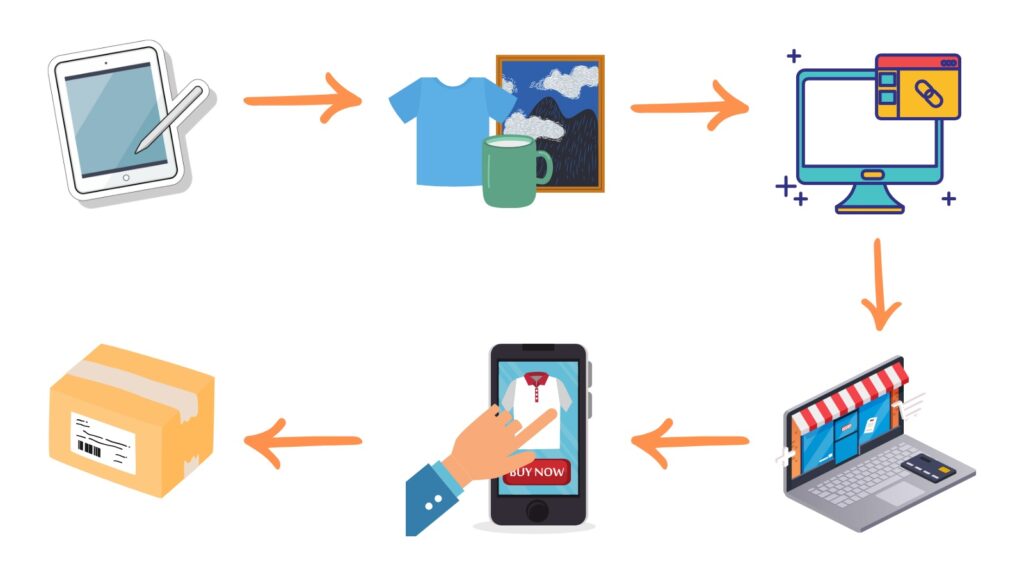
- Create your design: Start with crafting unique designs that you think will resonate with your target audience.
- Choose your products: Select from a variety of products to apply your designs to, ranging from apparel to home goods.
- Find a POD vendor: Partner with a print on demand service provider who will handle the printing and shipping directly to your customers.
- Set up your online store: Integrate your e-commerce platform with the POD service to showcase and sell your customised products.
- Customer makes a purchase: When a sale is made, the order is automatically forwarded to your POD vendor.
- Product is printed and shipped: The vendor prints your design on the chosen product and ships it directly to your customer under your brand name.
The Pros and Cons of Print of Demand
While the allure of launching a product line without upfront investment or inventory risks is compelling, like any business model, POD comes with its own set of unique advantages and challenges. So let’s take look at what makes it so appealing to many, alongside the considerations that should not be overlooked…
Pros
Low startup costs: There’s no need to purchase large quantities of inventory upfront, which significantly lowers the barrier to entry for new entrepreneurs – particularly attractive to those who want to start a business with limited capital.
No inventory management: Since products are only printed when a customer makes a purchase, you don’t need to manage or store inventory, eliminating the risk of overstocking or dealing with unsold products.
Easy to experiment and scale: You can easily test new designs and product ideas without financial risk. If a design becomes popular, scaling up is straightforward as there’s no need to guess inventory needs.
Automation potential: Many aspects of a POD business can be automated, from sales to fulfilment. Integration with e-commerce platforms allows for a mostly hands-off approach to order processing.
Customisation and personalisation: POD allows for easy customisation and personalisation, which can be a significant selling point as consumers increasingly look for unique or personalised products.
Global reach: With suppliers often handling worldwide shipping, it’s possible to sell products globally without dealing with international logistics.
Cons
Lower profit margins: The cost per item with POD is generally higher than buying in bulk from wholesalers so profit margins can be slimmer, which might require higher volumes of sales to make substantial profits.
Limited control over quality and fulfilment: As the manufacturing and shipping are outsourced, control over these processes is limited. This can lead to variability in product quality and fulfilment speeds, which may impact customer satisfaction.
Dependency on third-party providers: Your business is dependent on the reliability and stability of your POD provider. Any disruptions in their service, such as stock issues or technical problems, directly affect your business.
Shipping costs and times: Depending on where your products are printed and where your customers are located, shipping costs can be high, and delivery times can be long. This can be a disadvantage in a world where fast shipping is often expected.
Competition and market saturation: Due to the low entry barriers, many markets can become quickly saturated. Standing out among numerous competitors who may be selling similar products can be challenging.
Limited product range: While there are a ton of products available for POD, the range is still limited compared to what can be manufactured traditionally. This may restrict your ability to fully realise your creative visions or expand into certain product categories.
Environmental impact: Frequent shipping of single items, often internationally, can have a higher environmental footprint compared to bulk shipping to a single location.
Understanding these pros and cons will help you navigate the complexities of starting and managing a print on demand business more effectively. It’s essential to weigh these factors based on your specific business goals, target market, and personal preferences to determine if this model aligns with your entrepreneurial vision.
Which one to choose?
Choosing the right POD company is crucial; take your time to research and evaluate potential suppliers based on these criteria to ensure that your partnership will support and enhance your business objectives.
Firstly, assess the quality and range of products offered. Investigate the supplier’s printing technology to ensure they can deliver sharp, accurate reproductions of your designs. Also, consider the supplier’s fulfilment capabilities, including their average production times and ability to ship globally, as prompt and reliable delivery is crucial for customer satisfaction.
Ease of integration with e-commerce platforms should also be a priority to streamline your operations. The supplier should offer robust support for automatic order processing and have tools for tracking sales and inventory. Responsive customer support and a clear, fair return policy are essential to address any issues swiftly and maintain your reputation. Finally, consider their pricing structure and any potential hidden costs to ensure the partnership is economically viable, keeping in mind the importance of sustainability practices in today’s market.
By carefully evaluating these aspects, you can partner with a POD supplier that not only meets your business needs but also supports your growth and enhances your brand reputation.
Here are some PODs that have a strong operational base in the UK:
Printful: A globally recognised POD service with facilities in Europe, offering a wide product range, high-quality prints, and seamless integration with major e-commerce platforms.
TeeMill: Ideal for brands that value environmental consciousness and want to appeal to eco-aware customers, they provide an eco-friendly merchandise platform with organic products and renewable energy-powered manufacturing. UK-based.
Inkthreadable: Located in the UK, they specialise in a broad range of custom-printed products including clothing, accessories, and homeware with eco-friendly options and excellent platform integration, featuring no minimum order requirements.
Two Fifteen: A UK-based POD service known for its diverse product offerings including wall art, mugs, clothing, and phone cases with excellent customer service and quick delivery times across the UK.
Prodigi: Best known for high-quality art prints, Prodigi serves artists and photographers with top-notch printing quality and efficient global fulfilment, including within the UK.
Conclusion
The print on demand (POD) model offers huge potential for entrepreneurs looking to enter the e-commerce space with a flexible and low-risk approach. By allowing you to sell custom products without the burden of inventory management, POD can free you up to focus more on design, marketing, and scaling your business. This model is not only ideal for those just starting out but can also complement existing businesses seeking to expand their product offerings without significant upfront investment.
If you want to fast-track your way to running a successful online business, whether it be Print on Demand, Affiliate Marketing, Online Coaching or other e-commerce models, you can start by exploring the same training that I did.
It gave me the tools to understand my niche, re-discover my purpose and step by step guidance on how to set up my own online business. It also meant I was not alone! I joined an amazingly supportive community who are all busy building online businesses around their passions.
Click the link below to access this fantastic FREE training that will set you on the right path towards building a successful and sustainable online business.